
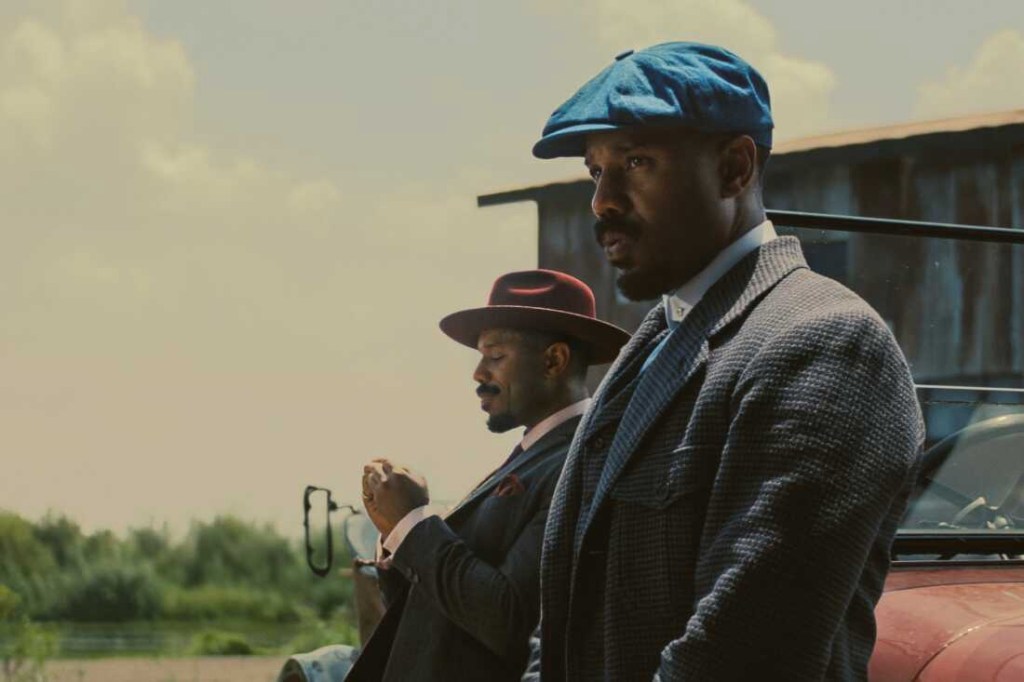
Michael B. Jordan plays twins Smoke and Stack in the new movie Sinners|📸: Warner Bros.©️
Note: This article contains spoilers for the movie Sinners
It’s not too often that I feel the need to pray in tongues to finish a movie, but that was my Saturday night when I saw Ryan Coogler’s new film, “Sinners.” After a long evening of eating dinner with the family in Topeka, we still decided to carve out time to see a movie we’d anticipated for months, even if that meant not getting home until after 1:00 at night. We were committed to seeing this film on opening night, come hell or high water.
As a proud millennial, very few movies or directors get us out of the house. If it’s not a Marvel film, there’s a strong chance I’ll stay home. Ryan Coogler is a different type of beast. For my money, no one currently in cinema is telling our stories with as much accuracy, thoughtfulness, and passion.
Two directors have set themselves apart in the last decade as a force to be reckoned with. Jordan Peele, director of films like “Get Out” and “Us” and producer of the highly anticipated new football-themed new aged-horror movie “Him”, and Mr. Coogler.
Set in 1930’s Mississippi, right in the middle of Jim Crow segregation, two bootlegging twins are set on opening a jukehouse after seemingly running from some trouble in Chicago (it was hinted that the twins had previously worked for Al Capone). They recruit their cousin Sammie, to the chagrin of his father, who pastors the local church, to perform that evening at the grand opening.
The film takes on the role of a blues song throughout, with rapturous crescendos and discordant breaks. Coogler revealed in a recent interview with Zachary Lee for RogerEbert.com that he intended the movie to come across that way.
I wanted the movie to feel like music and to have an aggressively dynamic range, Coogler said. To me, “Sinners” is a song in and of itself
-Ryan Coogler
He truly thought this movie through intimately and touched on numerous ideologies that Black people have held onto for centuries. The defining moment in the film, in my eyes (and seemingly everyone fortunate enough to see it), was about halfway through the movie.
Sammie, played by Miles Caton, is a gifted musician with a sultry singing voice. The film opens by explaining that some people are born with the gift of transcending time and space with their music. While it’s a gift, it can bring evil spirits into the vicinity. While Sammie is getting down at the jukehouse, the movie audience is taken on a joyous ride in a musical DeLorean of sorts. We start to see visions of different artists and musicians playing their respective genres along with Sammie and uniting the diaspora between time and space.
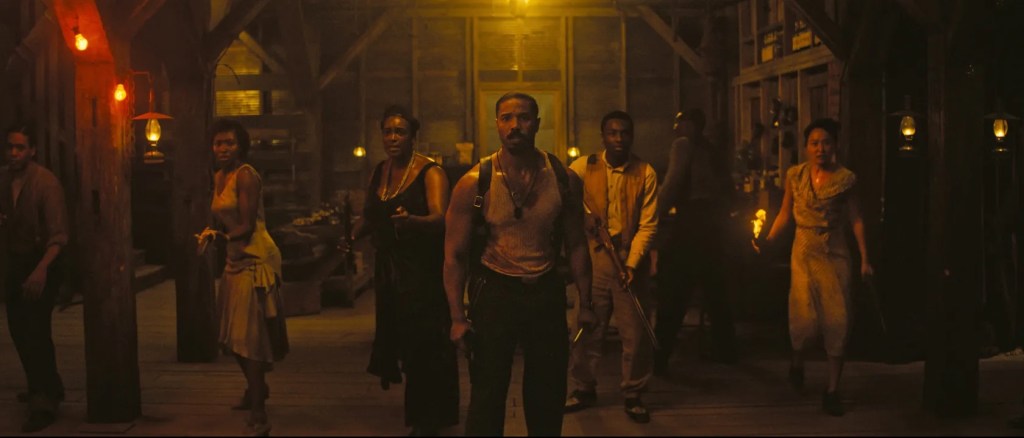
This vision was visible to the “spirits” or vampires who migrated through the Mississippi jukehouse but not the folks inside. Flames begin to engulf the jukehouse, and we see the roof start fizzling into the night sky like a burnt piece of paper would shrivel if thrown into the air. You saw African dancers, drummers, classical violinists, rappers from the 80s, and even Gen-Z kids twerking.
It was a hallucinatory sequence that certainly will put its audience in a trans. At that moment, I realized that “Sinners” was about to take me on a journey I could not imagine. The scene uncovered one of Coogler’s central themes in the movie. This moment when the spirits are triggered simultaneously tells the audience to love their culture and history no matter what tries to steal that magic away from them. It also highlights how music can blur lines of race and bring different cultures together in celebration.
Remmick, a centuries-old Irish immigrant, and the lead antagonist takes a keen interest in Sammie’s innate ability and seeks him out personally. He is drawn to his ability to channel his ancestors through his music, which weaves together different spaces of time and brings them all to one place. I found his character fascinating as his outward appearance cast him as a threat to the rest of the cast, but as he starts explaining his desires, we find out he wants the same things as Sammie.

Remmick survived for a long time, and I like that he sees the bullshit that is American racism. Rather than the KKK, he identifies with what’s going on in the juke joint, that he wants to be a part of it, and he wants all of them to be a part of him. He has this sales pitch that would be attractive to them.. ironically, they all think he’s the devil, but he’s something else. Vampirism is about sacrifice and what’s given up. You can get all this power, but the sacrifice is that you give up the ability for your soul to go on to the afterlife. You’re stuck in your body, and that’s a terrifying moorage
-Ryan Coogler
That he’s an Irish immigrant creates another layer left to uncover. If you study history, Irish people have a history of oppression. Furthermore, Irish culture and African-American culture have numerous similarities. Both faced discrimination and social scorn as second-class citizens. Frederick Douglass was famously moved and deeply inspired by Irish politician Daniel O’Connell, whose emancipation of Irish Catholics in 1829 granted them the ability to hold government seats and earned him the name “The Liberator.” He was also a well-known anti-slavery advocate.
Sinners explore countless ideologies, with each one having multiple layers. Whether it’s race, music, or vampirism, Sinners answers the call if you’re looking for an in-depth experience that takes you on a magical ride. Coogler has a way of combining themes and genres that are typically not intertwined in cinema. He is pushing the envelope when his fresh perspective and intellectual concepts not only entertain but force you to dig deeper and research the underlying messages he is trying to convey.
“If we do that right on the cast and crew side, and honestly, the audience feels that, and then they’ll be inspired to do the same thing,” Coogler shared. That’s why the film is in theaters now. It’s not just entertainment for entertainment’s sake; it’s participatory.”
 Bank On It!
Leave a comment