
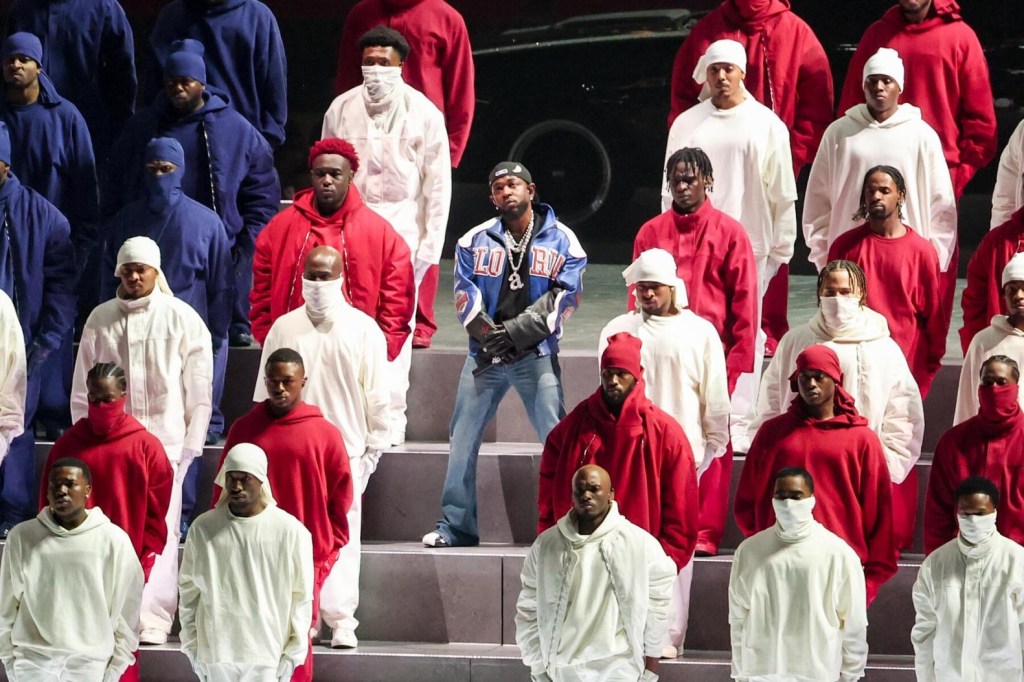
Cover Photo Credit: Christopher Polk|Penske Media
After his Super Bowl halftime show last Sunday, Kendrick Lamar has found his way back into the minds and tongues of people worldwide. This man is on a run for the ages, as the Compton-born rapper became the first solo rap artist to perform during the Super Bowl. Just a week before jumping on the biggest stage in the world, his diss track aimed at Canadian rapper/singer Drake, “Not Like Us,” received five Grammys.
It was the culmination of a year-long feud between the two artists, and it has now reached heights we could never have imagined. I’ve watched his Super Bowl performance five times, so I feel I have a strong concept of the message Kendrick was trying to relay to the world. It was simply flawless. Everything from the simple wardrobe (a far cry from last year when Usher looked like an auntie in his all-white pantsuit and glimmering top) to the execution of the songs and the visuals and camera angles. Despite the wide range of reactions towards the show, Roc Nation reported on Tuesday that 133.5 million viewers turned their TVs on to watch Lamar perform at halftime, the highest halftime audience ever recorded.

Kendrick Lamar is not new to this. Although short in stature at 5″ 5′, he has been a giant in the music industry for over a decade. Lamar is the only rapper ever to win a Pulitzer Prize. Music was a category that was added in 1943, and since its inception, it had been reserved for classical and jazz artists. Kendrick broke the mold by proving that a rapper can have the intellectual fortitude to receive an honor as prestigious as the Pulitzer. He won it in 2018 with the release of his album DAMN. Listen to the way the voters from Columbia University spoke about his work:
“A virtuosic song collection unified by its vernacular authenticity and rhythmic dynamism that offers affecting vignettes capturing the complexity of modern African-American life.”
– Pulitzer Prize Board
In short, he is one of the best storytellers hip-hop has ever seen, and very few have matched his mastery of the art form.

Kendrick Lamar accepts the 2018 Pulitzer Prize for Music from Columbia University President Lee Bollinger. (Photo: Eileen Barroso|Columbia University)
Yet, Lamar is being criticized for not being a worthy performer on a stage such as the Super Bowl. The music set list was leaked earlier in the week of the big game and was criticized on social media for being..boring. Kendrick has a ridiculously impressive discography and could have chosen dozens of other songs that were bigger hits with a broader appeal from previous albums. He didn’t play “Money Trees,” “Alright,” “Don’t Kill My Vibe,” “Swimming Pools,” or “Loyalty,” which all carry enormous streaming numbers collectively. The only songs that Lamar decided to play that weren’t from his most recent project, “GNX,” were “DNA” and “Humble.” Both of those fall into the mega-hit category, but there was a reason those were the only two he chose. It was no accident. He could have easily decided to go with a set list of his biggest hits, but that wouldn’t have satisfied Lamar’s heart. He was very calculated with the songs he chose. The masses may be confused about his performance, but I came away extremely impressed.
First of all, the choreography was simple yet stellar. Kendrick is no Michael Jackson, but he was able to show off the same three or four moves and make them look different and unique each time. The ordinary person does not understand the difficulty of singing/rapping all while running around performing choreography. He never sounded out of breath or out of rhythm. While that part was stunning, the actual symbolism throughout the night was exceptionally well done. Let’s get into it right now.
Uncle Sam/Uncle Tom:
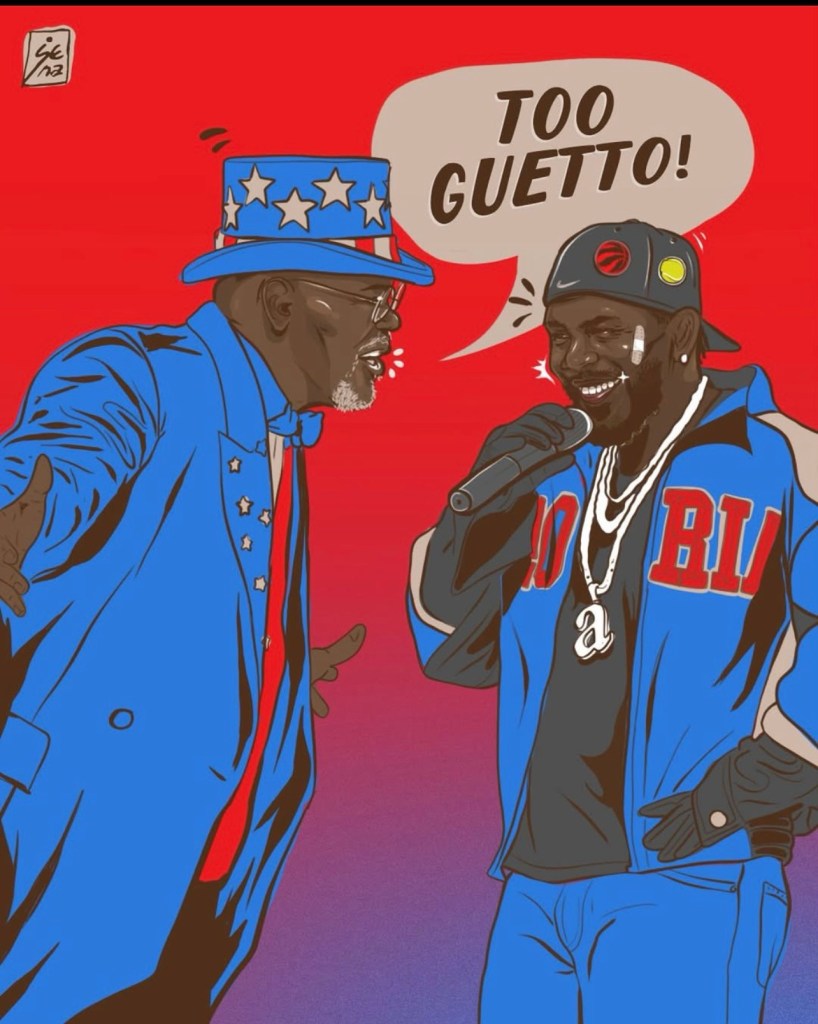
The tone was set immediately from the jump, with the first sound we heard being one of a man yelling. As the camera zooms in, we see none other than Samuel L. Jackson dressed as Uncle Sam in a top hat and star-and-spangled suit. “WELCOME TO THE GREAT AMERICAN GAME!” he shouted. As the performance went on, Uncle Sam would interject his advice between Lamar’s songs. “TOO LOUD, TOO RECKLESS, TOO GHETTO, MR LAMAR, DO YOU REALLY KNOW HOW TO PLAY THE GAME? THEN TIGHTEN UP!” he said. This was a hallmark case of Uncle Tom tropes in literature. If you have seen Django, Jackson plays another Uncle Tom character in that film, which is very reminiscent of his character at the Super Bowl (another calculated decision from Lamar).
“The Revolution’s About to Be Televised”

I don’t know about you and your household, but this was the first moment that I got an “OHH” moment from my family. As Lamar was standing on top of a black Buick GNX, a nod to his recent album, he started rapping this:
“I’m carrying heavier hearts right now I could power lift with Olympian’s too, I’m carrying varying darts right now I desert this (expletive) like Tiramisu (Tiramisu is a rich chocolate desert), we go body for body I hand you a body I’m probably a better masseuse, really don’t bother nobody but they run it by me if I gotta clear out the room, you would not get the picture if I had to sit you for hours in front of the Louvre (an art museum in Paris, France) would not have a soul not even if I had told you to stand next to Johnny and Q (A reference to the Denzel Washington movie John Q where a dad holds a hospital hostage so his son can receive a heart transplant), thought he was nothing but government cheese but now I can cease the government too(Lamar grew up in the infamous Compton, California neighborhoods and now has Trump in attendance and watching the halftime show), remember the food stamp color was tan and brown but now the hundreds are blue, remember I said I’m the greatest back when you debated the number one and number two, topic was always hilarious to me you carry them to me I brought out the broom.”
– Kendrick Lamar on “Bodies”
After Lamar wraps up his first song of the night, he then says this:
“The Revolution is about to be televised; you picked the right time but the wrong guy.”
– Kendrick Lamar at the Super Bowl
That quote was in reference to Gil Scott-Heron’s 1971 song “The Revolution Will Not Be Televised,” in which Heron’s main message was that you have to be active; you can’t be a passive participant in the revolution. You can’t sit and watch the revolution on television. In this case, Lamar was proclaiming that the revolution was happening at that very moment… but this time, it was televised.
The Video Game Theme

You may have noticed that the stage looked like a Playstation controller. That was by design as well. The stage was built to show Lamar’s life as a video game, each space being inspired by PlayStation buttons, triangle, circle, square, and X. This symbolizes how the Black experience is seen as a game to many, and our lives are not taken seriously. Just ask Shelley Rodgers, the halftime show’s art director who worked with Lamar on his vision for the entire performance. She told Wired,
“I think the (video game theme) was symbolic, his way to reach young people. A lot of it is showing his journey, traveling through the American dream.”
-SB 59 Art Director Shelley Rodgers
The American Flag

Lamar had all-black backup dancers who wore red, white, and blue. On the surface, most people probably thought it was a reference to gang culture, but it was more profound than that. They wore the costumes to look like an American flag, but they left space in the middle, showing a clear divide where Lamar stood and rapped. This was a clear picture of the current forecast in America, split by imaginary political lines. Another accurate interpretation would be that the black people making up the flag represent how we were the true people who built America. It was on the backs and shoulders of our ancestor’s slave labor that we were afforded what we have today. That conclusion became clear to me after he rapped, “40 acres and a mule, this is bigger than the music” later in the show.
Kendrick’s Jacket
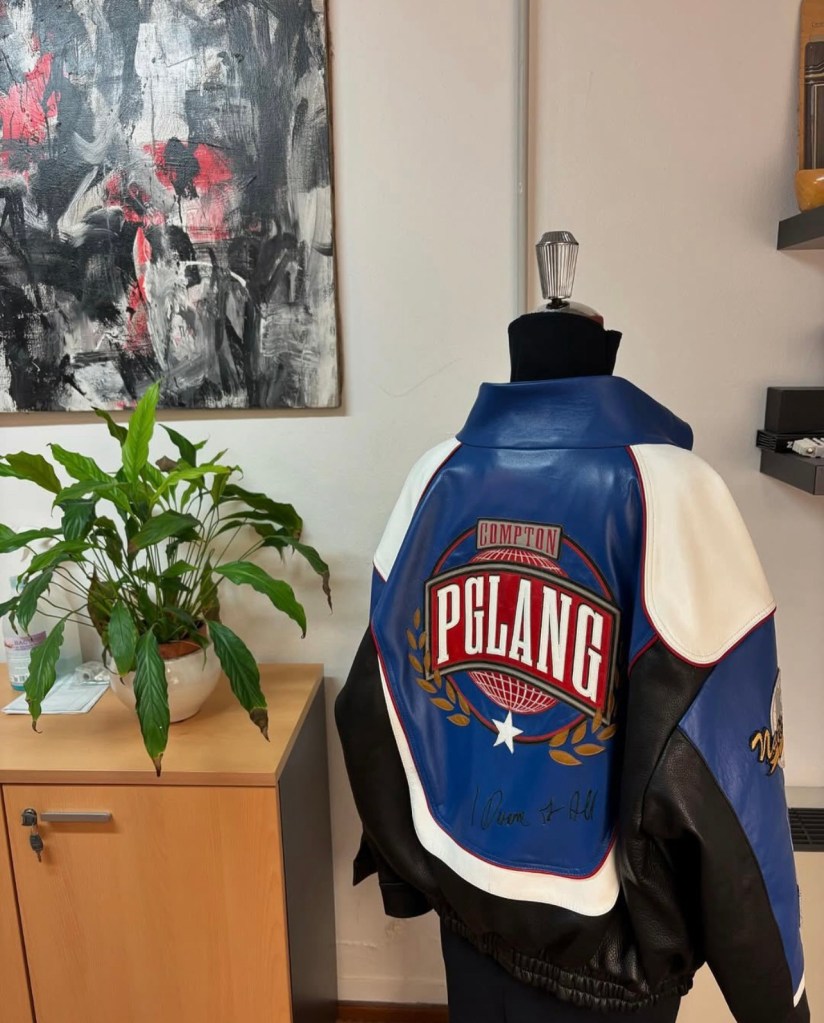
As I mentioned before, Kendrick’s drip was clean and effective. He sported a sapphire varsity jacket that dawned the words “Gloria.” It’s one of Lamar’s classic extended metaphors that’s a title to one of his songs with SZA (who also joined him on stage) and also the physical embodiment of his artistic gifts. Lamar refers to Gloria as the writing pen that he fell in love with as a teenager, which gave him the charisma to become who he is today. On the titled song, he says,
“Made a thousand mistakes, but never did we lack chemistry, wrappin’ my hand ’round your waist, remember when granny died? You looked at me and said Baby, dry your eyes. Depend on me as your relief; let your anger be mine.”
-Kendrick Lamar on “Gloria”
Duet with SZA

Lamar brought SZA out on stage to perform “Luther,” a track that samples Luther Vandross’ song “If This World Were Mine” and “All The Stars.” These were precise changes of pace compared to the previous tracks and were upbeat with more aggressive and confrontational lyrics. The tone was changed to soft, subdued, and sexy. That played right into Uncle Sam’s plan. “That’s what America wants! Nice and calm.” Of course, Kendrick followed SZA with “Not Like Us” and disregarded Uncle Sam’s suggestion to keep it calm.
There were countless other references and symbolism, but those are the main ones that stood out to me. It was not your typical Super Bowl halftime show, but it was true to Kendrick’s brand. It was thoughtful and calculated. Everything was set up to be a message about the black experience in America and to make the audience think and seek out more information. Education is the key to defeating ignorance and Lamar executed everything he wanted to achieve by not abiding by “normal” halftime rules. Many may not understand Kendrick Lamar, but for the ones that do, we know he is a true treasure to the art form of hip-hop and, most importantly, the Black community.
 Bank On It!
Leave a comment